
For women · Breast surgery

Breast liftin Berlin-Prenzlauer Berg

A lift raises the breast and reshapes it — without making it noticeably larger. Where volume is missing too, an implant or your own fat can be added in the same operation. Dr. Finke performs the procedure with a reconstructive background from hospital breast surgery.

Please note: A medical consultation is a chargeable service under the German physicians’ fee schedule (GOÄ). Online bookings are binding; the practice team will explain the expected consultation fee when arranging your appointment.

Medically reviewed by Dr. med. Juliane C. Finke and Dr. med. Stephan Frantzen · Board-certified plastic surgeons · Last reviewed:

Breast lift in Berlin – consultation at Finke & Frantzen
60–150 minutes in theatre, depending on technique, under general anaesthetic
One night as an inpatient at the MEOCLINIC, Friedrichstraße 71
1–2 weeks until you are back at work – two weeks for physical work
4–6 weeks no sport, supportive bra; walking is positively encouraged
Causes

Why does the breast drop – and what can you do yourself?

A breast lift — medically a mastopexy — is an operation that removes excess skin and repositions the breast tissue higher on the chest wall. The volume stays roughly the same: what gets tightened is the envelope, not the contents.

The breast has no muscle of its own. It is held by skin and by fine connective tissue strands, and both give way over time. Pregnancy and breastfeeding stretch them, marked weight loss empties the breast, and the skin loses elasticity with age. Genetics decide a great deal — some women notice it in their late twenties, others never really do.

What you can influence: a well-fitting sports bra during exercise, stable weight rather than repeated cycles of loss and gain, and no smoking. What you cannot influence: the quality of your connective tissue. Creams, massage and chest exercises do not lift a breast that has already dropped — the pectoral muscle sits behind the breast, not inside it.

Assessment

How is a dropped breast assessed?

The measure is not how the breast looks in a bra, but where the nipple sits in relation to the inframammary fold — the crease underneath the breast. Plastic surgeons use the Regnault classification:

  • Grade I – the nipple sits at the level of the fold. A small lift is usually enough.
  • Grade II – the nipple sits below the fold, but still above the lowest point of the breast.
  • Grade III – the nipple sits at the lowest point and points downwards.
  • Pseudoptosis – the nipple is still in position, but the tissue below it has emptied. This is the case where an implant or lipofilling often does more than a lift.

We measure this during your consultation, standing, with markings — not from a photograph. The grade determines the technique, and the technique determines the scar.

Scars

What scars will I have?

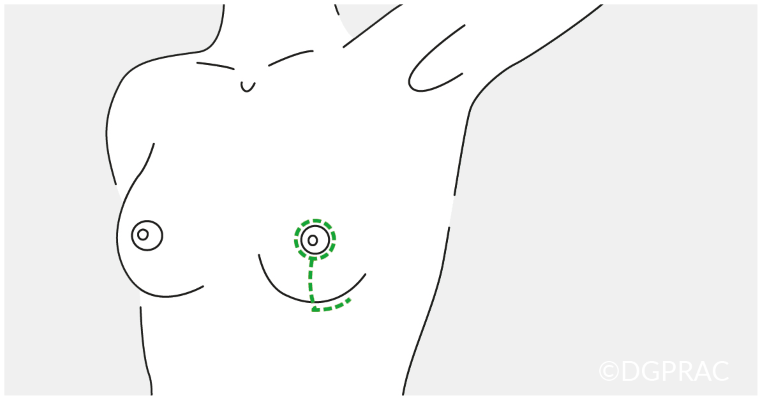
Illustration: scar patterns after a breast lift

Every lift leaves a scar. Anyone who promises otherwise is not being straight with you. What varies is how much:

  • Around the areola only (periareolar) – for small corrections. Least scarring, least lift.
  • Around the areola and vertically down (lollipop) – the standard technique for moderate ptosis.
  • Anchor pattern – vertical scar plus a scar in the inframammary fold, for a marked excess of skin.

Scars are red and firm for the first few months, then fade over one to two years to a pale line. How they turn out depends on your skin, on nicotine, and on whether you keep to the six-week limit on lifting and pulling. Silicone tape or gel helps; we will show you how to use it.

Where the fold is involved, the scar is hidden under the breast and is not visible in a bra or bikini. The vertical scar is the one that is occasionally visible — which is why we choose the smallest technique that will actually deliver the result.

Combining

Lipofilling and augmentation mastopexy

A lift raises and reshapes. It does not add volume — and in the upper half of the breast, which is what most women look at in the mirror, volume is often exactly what is missing.

Two options close that gap. Lipofilling uses your own fat, harvested by liposuction from the abdomen or thighs and injected into the breast. It gives a modest, natural gain; some of the transplanted fat is reabsorbed, so a second session is sometimes needed. An augmentation mastopexy combines lift and implant in one operation — more volume, more predictable, but with the considerations that come with any implant.

Which route suits you depends on how much tissue you have and how much change you want. We go through both in the consultation, including what each one costs you in scars and in recovery. See also breast augmentation.

Durability

How long does a breast lift last?

Ten years is a realistic figure, often longer. But the honest answer is: a lift resets the starting point, it does not stop the clock. Gravity, skin ageing and connective tissue carry on working.

Three things shorten the result more than anything else: a further pregnancy with breastfeeding, marked weight changes, and smoking. If you are still planning a family, it is usually worth waiting — not because the operation would be dangerous, but because you would be paying twice.

Safety

Risks specific to breast lift

Possible complications include bleeding, infection, wound-healing problems, conspicuous or widened scars, asymmetry, altered or permanently reduced nipple sensation, impaired blood supply to skin or nipple tissue, fat necrosis, recurrent drooping, impaired ability to breastfeed, thrombosis, embolism and revision surgery. Smoking, diabetes and circulatory disorders can increase healing risk.

From consultation to aftercare

How your breast lift proceeds

01

Consultation & planning

Examination, measurement of the breast and joint decision on breast size and technique – including a simulation of the target size. If your wish and what is realistically achievable do not match, we tell you so openly.

02

Preparation

In the two weeks before the operation, our anaesthetist informs you in detail. In the week before surgery, please take no blood-thinning medication such as aspirin or Thomapyrin. On the day of surgery you come to the clinic with an empty stomach.

03

Operation

Depending on the technique, the breast lift takes 60–150 minutes under general anaesthetic and is performed as a short inpatient stay at the MEOCLINIC on Friedrichstraße – you stay one night. You are operated on by the doctor who also advised you.

04

Aftercare

Check-ups after one, two and six weeks, after six months and after one year are included in the price. You receive a supportive bra for four to six weeks – please avoid sport and heavy lifting during this time.

At a glance

Breast lift: the key facts

Key facts about a breast lift at Finke & Frantzen in Berlin
How long60–150 minutes in theatre, depending on technique, under general anaesthetic
StayOne night as an inpatient for observation
Back to work1–2 weeks – two weeks for physically demanding work
Sport4–6 weeks off, supportive bra; walking encouraged from day one
ScarsAround the areola, vertical or anchor pattern – decided by the degree of ptosis
WhereConsultation and aftercare at our practice in Berlin-Prenzlauer Berg, the operation as an inpatient at the MEOCLINIC, Friedrichstraße 71 (private hospital in Quartier 206)
Paid byPrivate fee or private insurance benefit

What does a breast lift cost? There is no flat rate. Time in theatre, technique, anaesthetic and the extent of the procedure differ from person to person. You get a binding quote at the end of your consultation — in writing, with nothing hidden. And the consultation itself? Medical advice is a treatment in its own right and is invoiced under the German scale of medical fees (GOÄ) — including when you decide against a procedure afterwards. We tell you what to expect when the appointment is made.

Will insurance pay? As a rule, no: purely aesthetic procedures are paid privately. German statutory insurers only contribute where a medical indication is recognised; private insurers and international policies decide case by case. We will tell you honestly whether you have any prospect of cover.

Preparing

How do I prepare?

  • Stop blood thinners – aspirin, warfarin, ibuprofen – only after checking with us and your GP, usually ten to fourteen days beforehand.
  • Give up nicotine for two to four weeks before and after surgery. Smoking narrows the small skin vessels and is by far the most common cause of wound healing problems.
  • Come fasted on the day: nothing to eat for six hours, nothing to drink for two.
  • Arrange someone to take you home and, ideally, to stay the first night. No driving for 24 hours after a general anaesthetic.
  • Get things ready in advance: clothes that open at the front, the compression garment we agreed on, and enough food in for a few days.

These points apply generally. What applies in your case – with existing conditions or regular medication – we go through at your pre-operative consultation. That conversation is what counts.

Alternatives

What are the alternatives?

Whether it is the envelope or the contents that bothers you decides the operation. We look first at whether something smaller would do the job – and we will say so if none of these procedures fits your finding.

  • Breast augmentation – if the position is fine and only volume is missing – or combined as an augmentation mastopexy.
  • Breast reduction – if the breast is also too heavy; the lift is then part of the operation anyway.
  • Breast surgery overview – which procedure matches which finding.
In safe hands

Your surgeons for a breast lift in Berlin

Portrait of Dr. Juliane C. Finke, board-certified plastic surgeon in Berlin

Dr. Juliane C. Finke

Board-certified plastic surgeon (plastic &
aesthetic surgery), Fellow of EBOPRAS

  • Fellow of EBOPRAS – European board examination, 2010
  • Visiting surgeon at the breast centre of Krankenhaus Waldfriede, Berlin
  • Member of the German Society of Senology, the specialist society for breast disease
Portrait of Dr. Stephan Frantzen, board-certified plastic surgeon in Berlin

Dr. Stephan Frantzen

Board-certified plastic surgeon and
board-certified general surgeon

  • Head of department for plastic surgery, Helios Klinikum Berlin-Buch, 2015–2018
  • Board-certified in two specialties – general surgery and plastic surgery
  • Speaker on aesthetic breast surgery at national congresses
Verifiable qualifications

Professional societies and awards

jameda award: patients rated Dr. Frantzen 1.0, highest recommendation for breast augmentation – open Dr. Frantzen's jameda profile jameda seal TOP 10 (01/2022): Dr. med. Juliane C. Finke, physicians for plastic & aesthetic operations in Berlin – open Dr. Finke's jameda profile

Dr. Juliane C. Finke and Dr. Stephan Frantzen are full members of the German Society of Plastic, Reconstructive and Aesthetic Surgeons (DGPRÄC) and the German Society of Senology (DGS). Dr. Finke is also a Fellow of EBOPRAS and passed the European board examination in 2010; Dr. Frantzen operates on a voluntary basis for INTERPLAST in South America. The jameda seals lead to the independent physician profiles with patient reviews of Dr. Finke and Dr. Frantzen.

Frequently asked questions

Frequently asked questions about breast lifts

Medically reviewed by Dr. Juliane C. Finke and Dr. Stephan Frantzen

01

Will a breast lift make my breasts smaller?

Only slightly. A lift removes skin, not breast tissue, so the volume stays roughly the same — but a tightened breast often looks a little smaller because it no longer spreads out. If you want it genuinely smaller, that is a breast reduction; if you want more volume, an implant or lipofilling can be added in the same operation.

02

Can I still breastfeed afterwards?

In most techniques the nipple stays connected to the milk ducts and to its blood supply, so breastfeeding is usually still possible. A guarantee is not something anyone can give — it is not certain before a first pregnancy either. If you are still planning a family, we would generally suggest waiting.

03

Will I lose sensation in the nipple?

Reduced sensation in the first weeks is normal and settles in the great majority of cases over three to six months. A permanent change is uncommon but possible, and it is one of the points we go through in the consent discussion.

04

How visible are the scars?

For the first few months clearly; after one to two years they are usually a pale line. The scar in the inframammary fold is hidden by the breast. The vertical scar is the one that can occasionally be seen — which is why we use the smallest technique that will still give the result you want.

05

When can I sleep on my front again?

After about four weeks. For the first two weeks, sleeping on your back is the most comfortable option anyway; a wedge pillow helps.

06

Do I have to wear a bra day and night?

Yes, for four to six weeks. The supportive bra takes the weight off the fresh scars — it is the single most effective thing you can do for how the scar turns out.

07

Will insurance pay for a breast lift?

As a rule, no. A lift is regarded as an aesthetic procedure. The situation is different for a breast reduction with documented symptoms; there, an application for cover is possible.

08

Where does the operation take place?

Consultation and aftercare at our practice in Berlin-Prenzlauer Berg. The operation itself is performed as an inpatient at the MEOCLINIC, Friedrichstraße 71 — the private hospital in Quartier 206.

09

How soon can I fly?

Short flights after about a week, long-haul after two to three weeks — mainly because of the risk of thrombosis while sitting still. Tell us if you have travel planned and we will fit the date around it.

Your next step

Let’s talk about your breasts

Book a personal consultation. We measure, we examine, and we tell you honestly which technique fits — and what it will cost you in scars.

Related treatments: Breast augmentation · Breast reduction · Breast surgery · Liposuction · For women

Medically reviewed by Dr. Juliane C. Finke, board-certified plastic surgeon (plastic and aesthetic surgery), and Dr. Stephan Frantzen, board-certified plastic surgeon and board-certified general surgeon.
Last medically reviewed:
The content of this page is for general information and does not replace medical advice. A binding assessment is only possible after a personal examination.

Independent information: The German Society of Plastic, Reconstructive and Aesthetic Surgeons provides patient information on choosing a specialist, consent, limitations and possible complications. The German Medical Association explains the GOÄ fee schedule. These German-language sources supplement, but do not replace, an individual medical examination.

Call us Book an appointment