For women · Facial treatments

Wrinkle treatmentin Berlin-Prenzlauer Berg

Two kinds of line, two different treatments. Lines made by movement need the muscle relaxed; lines made by lost volume need the volume back. Treating the wrong one is why some results look odd — and why the first thing we do is work out which is which.

Please note: A medical consultation is a chargeable service under the German physicians’ fee schedule (GOÄ). Online bookings are binding; the practice team will explain the expected consultation fee when arranging your appointment.

Medically reviewed by Dr. med. Juliane C. Finke and Dr. med. Stephan Frantzen · Board-certified plastic surgeons · Last reviewed:

Wrinkle treatment in Berlin – consultation at Finke & Frantzen
About 30 minutes treatment time, depending on the size of the area
Local anaesthetic usually – hyaluronic acid already contains an anaesthetic
Day case no hospital stay, and you are usually presentable straight away
3–10 days for botulinum toxin to take full effect – hyaluronic acid works at once
The distinction

Expression lines or volume lines?

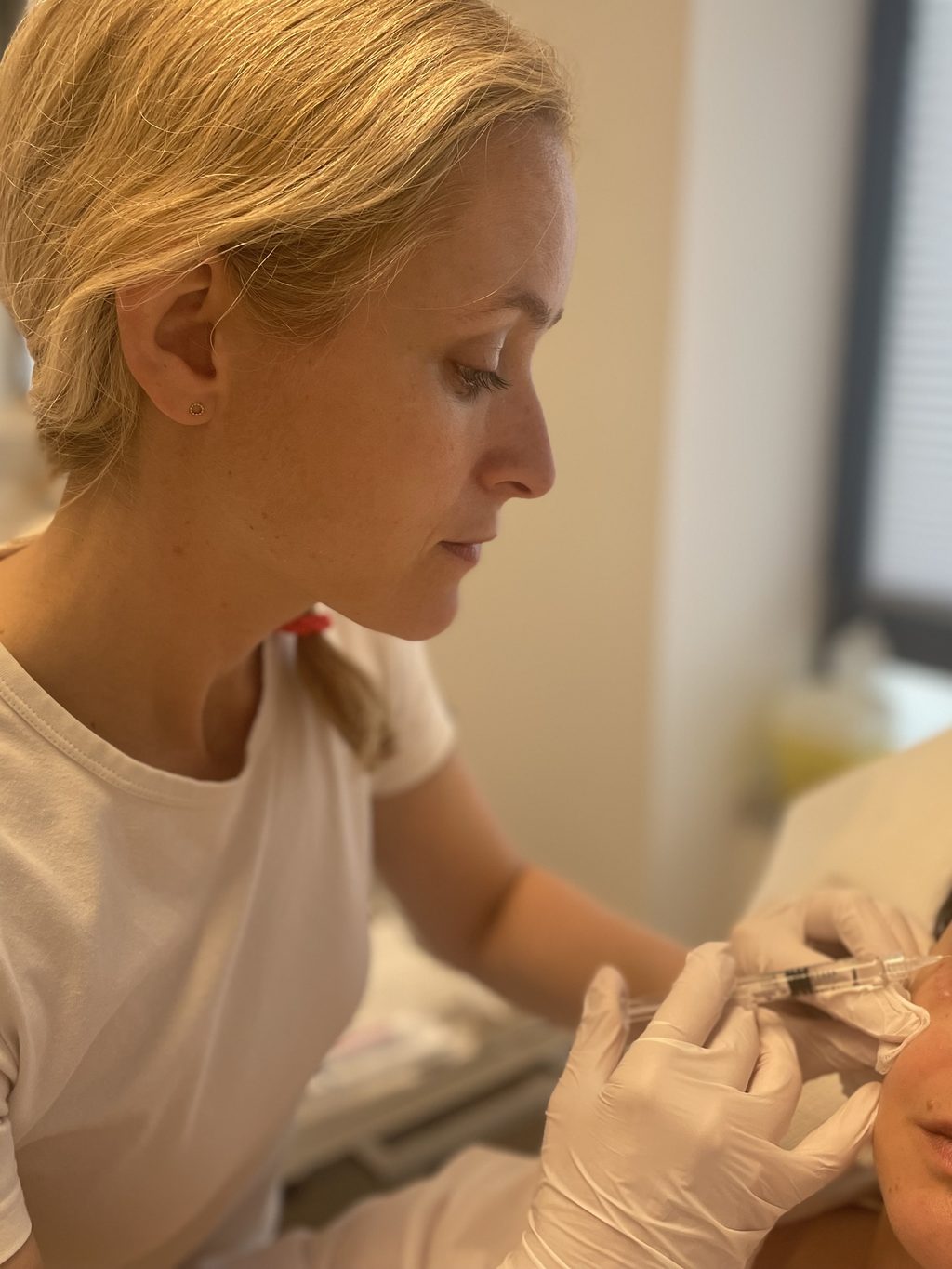
Wrinkle treatment is the non-surgical smoothing of lines with injectable preparations: botulinum toxin relaxes the muscle that creates a line, while hyaluronic acid and autologous fat replace volume that has been lost.

The test takes a second. Look in a mirror with your face completely still. Lines you can still see are volume lines — the tissue underneath has gone. Lines that only appear when you frown, smile or raise your brows are expression lines, made by muscle.

Filling an expression line makes the area look bulky when you move. Relaxing a volume line does nothing at all. Most faces have both, which is why the two are often combined — and why the proportion matters more than the products.

Muscle

Botulinum toxin: relaxing the muscle

Botulinum toxin blocks the signal from nerve to muscle at the point of injection. The muscle stops contracting as strongly, and the line it was folding into the skin softens or disappears. Its intended effect is a temporary, local weakening of selected muscles; excessive or misplaced effect can reduce movement in unintended areas.

Classic areas: the frown lines between the brows, horizontal forehead lines, and crow’s feet at the outer corner of the eye. Smaller doses are also used to lift the outer brow slightly, to soften a gummy smile, or to reduce a dimpled chin.

  • Onset – first effect after about three days, full effect after up to ten.
  • Duration – four to six months on average. It tends to last longer with repeated treatment as the muscle becomes less strong.
  • Downtime – none. Small red points at the injection sites for an hour or two.

One rule we do keep to: no treatment on the day of an important event. Not because anything goes wrong, but because the effect is not there yet and the tiny marks are.

Volume

Hyaluronic acid: replacing what has gone

Hyaluronic acid occurs naturally in the skin, where it binds water and gives tissue its firmness. The injectable version is a gel of the same substance in cross-linked form, so it stays where it is placed and is broken down slowly.

It is used where volume has been lost — temples, cheeks, the fold from nose to mouth, marionette lines, the lips, and the tear trough between lid and cheek. It can also be used to sharpen the chin and jawline.

  • Onset – immediate; the final shape is visible once the swelling settles after two or three days.
  • Duration – nine to eighteen months, depending on the product and the area. Lips break down fastest; the jawline lasts longest.
  • Partly reversible – hyaluronidase can be used in some situations, but complete and risk-free reversal cannot be guaranteed.

Some preparations contain local anaesthetic; numbing cream or additional anaesthetic may be used where appropriate. Pain, swelling and bruising remain possible.

Own fat

Autologous fat: your own material

For larger volume deficits, fat taken from your own abdomen or thighs by small-volume liposuction can be injected into the face. It is prepared and placed in fine layers.

The advantages: your own tissue, no foreign material, and the portion that survives stays permanently. The trade-off: it is a small operation rather than an appointment, some of the transferred fat is reabsorbed over the first months, and a second session is sometimes needed to reach the final result.

We suggest it where a face has lost substantial volume overall — filling that with hyaluronic acid alone would need a great deal of product and would have to be repeated indefinitely.

Our approach

Why we use less than you might expect

Almost everything that makes injectable treatment look bad comes from too much product, not from the product itself. Frozen foreheads, over-full cheeks, lips that arrive before their owner — all of them are dosing decisions.

We deliberately treat conservatively, and we would rather see you again in two weeks to add a little than take something away that cannot be taken away. With hyaluronic acid it can be dissolved; with fat it cannot.

The other thing we do is treat the cause rather than the line. A deep fold from nose to mouth is often not a problem of that fold at all — it is a cheek that has descended. Filling the fold makes the face heavier; supporting the cheek fixes it.

How it works

How does a wrinkle treatment proceed?

In a personal consultation we develop an individual treatment plan with you – maximum success with minimum effort.

01

Consultation

At your first visit, the treating doctor holds a detailed consultation. All treatment options are discussed – as are alternatives and possible risks.

02

Treatment plan

Together, a plan for your individual areas takes shape. We address what bothers you and start where the effect is greatest.

03

The treatment

After careful disinfection of the skin, the appropriate product is injected. Small treatments can usually be carried out during the first consultation.

04

Afterwards

Redness, swelling, tenderness or bruising may be temporarily visible. Whether and when make-up, sport or other activities are possible depends on the product, the region and your individual course of healing.

Safety

Risks and warning signs

Hyaluronic-acid fillers can cause pain, swelling, bruising, nodules, infection, asymmetry and delayed inflammatory reactions. Rarely, filler may enter or obstruct a blood vessel, causing tissue injury and – particularly in the face – visual impairment or loss of vision. Severe or increasing pain, pale or mottled skin, or any visual symptom requires urgent medical assessment.

Botulinum toxin can cause headache, asymmetry, unintended muscle weakness or temporary eyelid droop. Difficulty swallowing, speaking or breathing requires immediate medical help. Effects and risks depend on product, dose, injection site and medical history.

Current regulatory information: Germany’s BfArM on fillers and BfArM on botulinum toxin.

At a glance

Wrinkle treatment: the key facts

Key facts about wrinkle treatment at Finke & Frantzen in Berlin
How longAbout 30 minutes, depending on the size of the area
AnaestheticDepends on product and area – some fillers contain local anaesthetic
OnsetHyaluronic acid immediately; botulinum toxin after 3–10 days
DurationBotulinum toxin 4–6 months, hyaluronic acid 9–18 months
DowntimeNone to two days – small bruises are possible
WhereDay surgery at our practice, Heinrich-Roller-Straße 15, Berlin-Prenzlauer Berg
Paid byPrivate fee, billed according to the German scale of medical fees (GOÄ)

What does wrinkle treatment cost? There is no flat rate. Time in theatre, technique, anaesthetic and the extent of the procedure differ from person to person. You get a binding quote at the end of your consultation — in writing, with nothing hidden. And the consultation itself? Medical advice is a treatment in its own right and is invoiced under the German scale of medical fees (GOÄ) — including when you decide against a procedure afterwards. We tell you what to expect when the appointment is made.

Will insurance pay? As a rule, no: purely aesthetic procedures are paid privately. German statutory insurers only contribute where a medical indication is recognised; private insurers and international policies decide case by case. We will tell you honestly whether you have any prospect of cover.

Preparing

How do I prepare?

  • Stop blood thinners – including fish oil and vitamin E supplements – a few days beforehand after checking with us. It makes a real difference to bruising.
  • Avoid alcohol the day before.
  • Come without make-up; we clean and disinfect the skin before treating.
  • Do not book the appointment right before an important event. Swelling and small bruises are normal and need a few days.
  • Tell us if you have a vaccination, dental work or an infection coming up – we would rather postpone.

These points apply generally. What applies in your case – with existing conditions or regular medication – we go through at your pre-operative consultation. That conversation is what counts.

Alternatives

What are the alternatives?

Injections treat lines and volume — not a contour that has slipped. We look first at whether something smaller would do the job – and we will say so if none of these procedures fits your finding.

  • Thread lift – lifts the contour rather than smoothing individual lines.
  • FaceTite – tightens the skin from beneath, for jawline and under the chin.
  • Facelift – if the face has genuinely descended, adding volume makes it heavier, not younger.
  • Bullhorn lip lift – if the upper lip is not thin but too long – filler will not shorten it.
In safe hands

Your specialists for wrinkle treatment in Berlin

Portrait of Dr. Juliane C. Finke, board-certified plastic surgeon in Berlin

Dr. Juliane C. Finke

Board-certified plastic surgeon (plastic &
aesthetic surgery), Fellow of EBOPRAS

  • Fellow of EBOPRAS – European board examination, 2010
  • Injectable treatments with botulinum toxin, hyaluronic acid and autologous fat
  • Consultations in English and Spanish
Portrait of Dr. Stephan Frantzen, board-certified plastic surgeon in Berlin

Dr. Stephan Frantzen

Board-certified plastic surgeon and
board-certified general surgeon

  • Speaker on the “Full Face Approach” at the VDÄPC annual meeting
  • Instructor for thread lifting, University Dermatology Clinic Tübingen, 2020–2022
  • Board-certified in two specialties – general surgery and plastic surgery
Verifiable qualifications

Professional societies and awards

jameda award: patients rated Dr. Frantzen 1.0, highest recommendation for breast augmentation – open Dr. Frantzen's jameda profile jameda seal TOP 10 (01/2022): Dr. med. Juliane C. Finke, physicians for plastic & aesthetic operations in Berlin – open Dr. Finke's jameda profile

Dr. Juliane C. Finke and Dr. Stephan Frantzen are full members of the German Society of Plastic, Reconstructive and Aesthetic Surgeons (DGPRÄC) and the German Society of Senology (DGS). Dr. Finke is also a Fellow of EBOPRAS and passed the European board examination in 2010; Dr. Frantzen operates on a voluntary basis for INTERPLAST in South America. The jameda seals lead to the independent physician profiles with patient reviews of Dr. Finke and Dr. Frantzen.

Frequently asked questions

Frequently asked questions about wrinkle treatment

Medically reviewed by Dr. Juliane C. Finke and Dr. Stephan Frantzen

01

Which preparation do you use?

Botulinum toxin type A, in one of several licensed preparations, chosen according to the area being treated. German law does not permit us to name prescription-only medicines by brand on a public page, which is why these pages speak of botulinum toxin rather than any trade name. In the consultation we will tell you exactly which product we are using and why.

02

Will my face look frozen?

Not at the doses we use. A completely immobile forehead is the result of over-treatment. Properly dosed, you can still raise your brows — the line simply does not fold as deeply. If you want no movement at all, we are not the right practice.

03

How long does it last?

Botulinum toxin four to six months, and often slightly longer with repeated treatment. Hyaluronic acid nine to eighteen months depending on product and area — lips break down fastest, the jawline lasts longest.

04

Does it hurt?

Both treatments involve needle injections and can be painful. Some fillers contain local anaesthetic; numbing cream or additional anaesthetic may be used, particularly for the lips.

05

Can it be reversed if I do not like it?

Hyaluronidase can reduce hyaluronic-acid filler in some situations, but the response may require more than one treatment and complete reversal cannot be guaranteed. Botulinum toxin cannot be reversed and wears off over time.

06

Can I go back to work straight afterwards?

Usually yes. Small red points settle within an hour or two. Bruising is possible, particularly around the lips and under the eyes, so allow two or three days if you have something important coming up.

07

Is there anything I should avoid afterwards?

For the rest of the day: no lying flat, no sport, no sauna, and do not rub the treated area. After botulinum toxin, stay upright for four hours.

08

What does it cost?

Billed according to the German scale of medical fees, and it depends on the product and the quantity used. We tell you the price before treating, not after — and we will say when a smaller amount would do the same job.

09

Can I combine it with surgery?

Yes. Injectables are often used alongside eyelid surgery or a facelift, and they are also what maintains a surgical result over the following years.

Your next step

Let’s look at your face together

Book a personal consultation. We work out which lines are muscle and which are volume — and treat the cause rather than the line.

Related treatments: Thread lift · Eyelid surgery · Bullhorn lip lift · Facelift · Facial treatments

Medically reviewed by Dr. Juliane C. Finke, board-certified plastic surgeon (plastic and aesthetic surgery), and Dr. Stephan Frantzen, board-certified plastic surgeon and board-certified general surgeon.
Last medically reviewed:
The content of this page is for general information and does not replace medical advice. A binding assessment is only possible after a personal examination.

Independent information: The German Society of Plastic, Reconstructive and Aesthetic Surgeons provides patient information on choosing a specialist, consent, limitations and possible complications. The German Medical Association explains the GOÄ fee schedule. These German-language sources supplement, but do not replace, an individual medical examination.

Call us Book an appointment