For women · Breast surgery

Breast reductionin Berlin-Prenzlauer Berg

Neck and back pain, grooves from bra straps, skin irritation underneath, and sport that stops being fun — a breast that is too heavy is rarely only an aesthetic question. A reduction removes tissue and skin, and lifts and reshapes the breast in the same operation.

Please note: A medical consultation is a chargeable service under the German physicians’ fee schedule (GOÄ). Online bookings are binding; the practice team will explain the expected consultation fee when arranging your appointment.

Medically reviewed by Dr. med. Juliane C. Finke and Dr. med. Stephan Frantzen · Board-certified plastic surgeons · Last reviewed:

Breast reduction in Berlin – consultation at Finke & Frantzen
120–180 minutes in theatre, depending on technique, under general anaesthetic
One night as an inpatient for observation – longer on request
2 weeks until you are back at work; take it easy for one to three weeks
4–6 weeks no sport, compression bra, sometimes with a stabilising strap
Indication

When does a breast reduction make sense?

A breast reduction — medically a reduction mammoplasty — removes glandular tissue, fat and excess skin, and repositions the nipple. Because the breast is lifted and reshaped at the same time, a lift is always part of the operation.

The decision is rarely about a cup size. It is usually about a list that patients recite almost word for word: pain between the shoulder blades that starts in the afternoon, deep grooves where the bra straps sit, recurring skin irritation or fungal infection in the fold underneath, and the daily business of finding clothes that fit at the top and the bottom.

Add to that the things people mention more quietly — being looked at since your teens, avoiding sport, sleeping badly. None of that is vanity, and we do not treat it as such.

Timing

When is the right time?

Two conditions matter more than age. First, breast development should be complete — that is usually the case from about 18. Second, your weight should be stable; substantial weight loss after the operation changes the result, and gaining weight can partly undo it.

Family planning is the other question. Pregnancy and breastfeeding change the breast again, so if children are still planned it is often worth waiting. If that is years away, there is a fair argument for not spending those years in pain. We will talk it through rather than give you a rule.

The operation

How is a breast reduction performed?

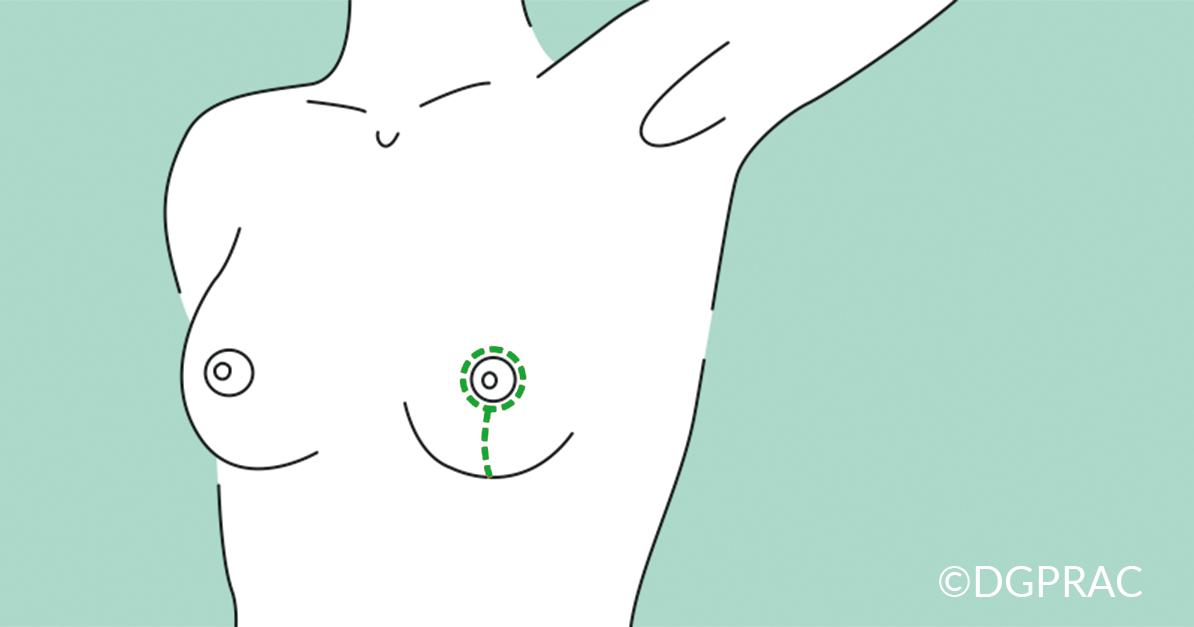
Illustration: technique of a breast reduction

You are marked up standing, before the anaesthetic — sitting or lying changes where everything sits, so this cannot be done on the table. Under general anaesthetic, glandular tissue and fat are then removed, and the nipple is moved upwards on a pedicle of tissue that keeps its blood supply and, as far as possible, its nerve supply intact.

The excess skin is removed last and the breast is closed under moderate tension. Drains are used in some cases and come out after a day or two. The whole thing takes between two and three hours depending on how much is removed.

You stay one night for observation. Most patients are surprised by how immediately the back feels different — that part is not gradual.

Scars

What scars will I have?

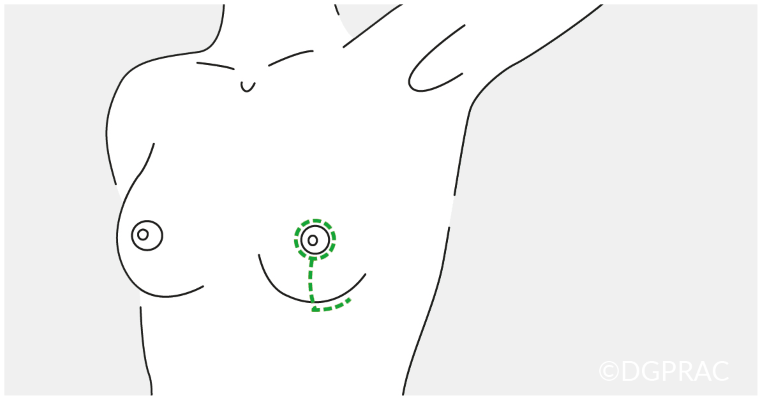
Illustration: scar patterns after a breast reduction

Two patterns cover almost every case:

  • Lollipop – around the areola and vertically down to the fold. For moderate reductions.
  • Anchor – the same, plus a scar along the inframammary fold. For larger reductions, where more skin has to go.

The scar in the fold is hidden by the breast itself and is not visible in a bra or bikini. Scars are red and raised for several months, then fade over one to two years. Silicone tape from around week three helps; nicotine is the single worst thing for them.

Breastfeeding

Can I breastfeed after a breast reduction?

Often yes — but less reliably than after a lift. The nipple stays attached to a pedicle of tissue that contains milk ducts, so the connection is preserved by design. How much functioning glandular tissue remains depends on how much had to be removed.

Honest summary: many women who have had a reduction breastfeed successfully, some partially, some not at all. No surgeon can promise it — and it is worth remembering that breastfeeding does not work for every woman who has never had surgery either. If breastfeeding matters a great deal to you, say so; it influences the technique we choose.

From consultation to aftercare

How your breast reduction proceeds

The specialist you choose remains your treating doctor for the entire course of treatment – consultation, informed consent, operation and aftercare from one source.

01

Consultation & preparation

Examination, decision on target size and technique. The anaesthetist informs you in the two weeks before surgery. If you have a history of breast disease or a family history, an imaging examination (ultrasound, mammography) may be advisable – we are happy to coordinate this with your gynaecologist.

02

The day of surgery

You are welcomed on the ward; your treating doctor visits you before the procedure and marks the incision lines. Throughout the entire process you are accompanied by trained specialist staff. After the operation, too, your doctor comes to see you, reports on how it went and checks the dressings.

03

Hospital stay

Breast reduction is performed as an inpatient procedure: you stay one day in the clinic for monitoring. If you wish, you are welcome to extend your stay – as a rule, our patients leave the clinic the day after the operation.

04

Aftercare

Closely at first: appointments one and two weeks after surgery. During this time you receive a telephone number on which we can be reached around the clock in urgent cases. After that the intervals become longer: after three months we assess the scarring, after one year the final examination follows.

Costs

Will insurance cover a breast reduction?

This is the one procedure in aesthetic surgery where the answer is genuinely sometimes yes.

German statutory insurance may contribute where there is a documented medical indication — typically persistent back and neck pain, recurring skin problems in the fold, and evidence that conservative treatment such as physiotherapy has been tried. You apply to your insurer; we support you with the documentation, photographs and the surgical report. The decision is theirs, not ours, and a refusal at the first attempt is common.

Private insurers and international policies decide case by case, usually on the same criteria. If you are insured outside Germany, check before you travel — many international policies exclude the procedure regardless of symptoms.

A note on medical certificates: sick leave can only be issued where the insurer has accepted the procedure as medically indicated. For a purely aesthetic reduction, you will need to book holiday.

Safety

Risks specific to breast reduction

Possible complications include bleeding, infection, wound-healing problems, conspicuous scars, asymmetry, altered or permanently reduced nipple sensation, impaired blood supply or tissue loss, fat necrosis, reduced ability to breastfeed, thrombosis, embolism and revision surgery. Risk rises with factors such as smoking, diabetes, very large reductions and impaired circulation.

At a glance

Breast reduction: the key facts

Key facts about a breast reduction at Finke & Frantzen in Berlin
How long120–180 minutes in theatre, under general anaesthetic
StayOne night as an inpatient for observation, longer on request
Back to work2 weeks; take it easy for one to three weeks
Sport4–6 weeks off, compression bra, sometimes with a strap
ScarsLollipop or anchor pattern, depending on how much is removed
WhereConsultation and aftercare at our practice in Berlin-Prenzlauer Berg, the operation as an inpatient at the MEOCLINIC, Friedrichstraße 71 (private hospital in Quartier 206)
Paid byPrivate fee – or statutory insurance where a medical indication is accepted

What does a breast reduction cost? There is no flat rate. Time in theatre, technique, anaesthetic and the extent of the procedure differ from person to person. You get a binding quote at the end of your consultation — in writing, with nothing hidden. And the consultation itself? Medical advice is a treatment in its own right and is invoiced under the German scale of medical fees (GOÄ) — including when you decide against a procedure afterwards. We tell you what to expect when the appointment is made.

Will insurance pay? As a rule, no: purely aesthetic procedures are paid privately. German statutory insurers only contribute where a medical indication is recognised; private insurers and international policies decide case by case. We will tell you honestly whether you have any prospect of cover. For a breast reduction specifically, an application is realistic where symptoms are documented — see the section above.

Preparing

How do I prepare?

  • Stop blood thinners – aspirin, warfarin, ibuprofen – only after checking with us and your GP, usually ten to fourteen days beforehand.
  • Give up nicotine for two to four weeks before and after surgery. Smoking narrows the small skin vessels and is by far the most common cause of wound healing problems.
  • Come fasted on the day: nothing to eat for six hours, nothing to drink for two.
  • Arrange someone to take you home and, ideally, to stay the first night. No driving for 24 hours after a general anaesthetic.
  • Get things ready in advance: clothes that open at the front, the compression garment we agreed on, and enough food in for a few days.

These points apply generally. What applies in your case – with existing conditions or regular medication – we go through at your pre-operative consultation. That conversation is what counts.

Alternatives

What are the alternatives?

Weight, position and volume are three different problems. We look first at whether something smaller would do the job – and we will say so if none of these procedures fits your finding.

  • Breast lift – if the weight is acceptable and only the position has changed.
  • Liposuction – in selected cases of a predominantly fatty breast with firm skin, though it does not lift.
  • Breast surgery overview – which procedure matches which finding.
In safe hands

Your surgeons for a breast reduction in Berlin

Portrait of Dr. Juliane C. Finke, board-certified plastic surgeon in Berlin

Dr. Juliane C. Finke

Board-certified plastic surgeon (plastic &
aesthetic surgery), Fellow of EBOPRAS

  • Fellow of EBOPRAS – European board examination, 2010
  • Visiting surgeon at the breast centre of Krankenhaus Waldfriede, Berlin
  • Member of the German Society of Senology, the specialist society for breast disease

Portrait of Dr. Stephan Frantzen, board-certified plastic surgeon in Berlin

Dr. Stephan Frantzen

Board-certified plastic surgeon and
board-certified general surgeon

  • Head of department for plastic surgery, Helios Klinikum Berlin-Buch, 2015–2018
  • Board-certified in two specialties – general surgery and plastic surgery
  • Years of hospital experience in reconstructive breast surgery
Verifiable qualifications

Professional societies and awards

jameda award: patients rated Dr. Frantzen 1.0, highest recommendation for breast augmentation – open Dr. Frantzen's jameda profile jameda seal TOP 10 (01/2022): Dr. med. Juliane C. Finke, physicians for plastic & aesthetic operations in Berlin – open Dr. Finke's jameda profile

Dr. Juliane C. Finke and Dr. Stephan Frantzen are full members of the German Society of Plastic, Reconstructive and Aesthetic Surgeons (DGPRÄC) and the German Society of Senology (DGS). Dr. Finke is also a Fellow of EBOPRAS and passed the European board examination in 2010; Dr. Frantzen operates on a voluntary basis for INTERPLAST in South America. The jameda seals lead to the independent physician profiles with patient reviews of Dr. Finke and Dr. Frantzen.

Frequently asked questions

Frequently asked questions about breast reduction

Medically reviewed by Dr. Juliane C. Finke and Dr. Stephan Frantzen

01

How much smaller will my breasts be?

That is agreed beforehand, not decided in theatre. We work from your symptoms, your build and what you want — usually two to four cup sizes. Going as small as possible is rarely the right answer: the breast still has to suit your frame, and very large reductions carry more risk to nipple blood supply.

02

Does a breast reduction hurt a lot?

Less than most people expect. There is pressure and tightness for the first two or three days, controlled with ordinary painkillers. Many patients say the back pain they came in with disappeared faster than the soreness from the operation.

03

How long does the operation take?

Two to three hours, depending on how much tissue is removed and which technique is used.

04

Will I lose sensation in the nipple?

Reduced sensation for the first weeks is normal and recovers in most cases over three to six months. A permanent change is possible and more likely in very large reductions — it is one of the points we go through before you consent.

05

Can I breastfeed afterwards?

Often, but not reliably. The nipple keeps its connection to the milk ducts by design; how much functioning gland remains depends on how much had to be removed. Tell us if breastfeeding matters to you — it influences the technique.

06

Will my statutory insurance pay?

It may, where a medical indication is documented: persistent back and neck pain, recurring skin problems under the breast, and conservative treatment already tried. You apply, we supply the documentation. The decision rests with your insurer.

07

Can I get a sick note?

Only where the insurer has accepted the procedure as medically indicated. For a purely aesthetic reduction you will need to take holiday.

08

When can I drive again?

Once you can make an emergency stop without hesitating — usually after one to two weeks. Not while you are still taking strong painkillers.

09

Where does the operation take place?

Consultation and aftercare at our practice in Berlin-Prenzlauer Berg. The operation is performed as an inpatient at the MEOCLINIC, Friedrichstraße 71 — the private hospital in Quartier 206.

Your next step

Let’s talk about your breasts

Book a personal consultation. We examine, measure and tell you honestly what is realistic — including whether an application to your insurer has any prospect of success.

Related treatments: Breast lift · Breast augmentation · Breast surgery · Liposuction · For women

Medically reviewed by Dr. Juliane C. Finke, board-certified plastic surgeon (plastic and aesthetic surgery), and Dr. Stephan Frantzen, board-certified plastic surgeon and board-certified general surgeon.
Last medically reviewed:
The content of this page is for general information and does not replace medical advice. A binding assessment is only possible after a personal examination.

Independent information: The German Society of Plastic, Reconstructive and Aesthetic Surgeons provides patient information on choosing a specialist, consent, limitations and possible complications. The German Medical Association explains the GOÄ fee schedule. These German-language sources supplement, but do not replace, an individual medical examination.

Call us Book an appointment