
Finke & Frantzen · Berlin
Nasolabial fold treatmentConsultation in Berlin-Prenzlauer Berg
The lines between the nose and mouth are part of an expressive face. If they bother you, hyaluronic acid may soften them in suitable cases. The important question is not the fold alone, but how skin, cheek volume and facial expression work together.
Medical consultations are subject to a fee. Treatment costs are discussed individually during your consultation.

ConsultationPersonal and open-ended
IndividualPlanning based on assessment
TransparentOptions and risks
BerlinPractice in Prenzlauer Berg
Treating nasolabial folds: the important distinction
Hyaluronic acid can soften a nasolabial fold in suitable cases by adding local volume. It does not remove excess skin. Adding cheek filler does not reliably lift the fold in everyone. Our consultation therefore distinguishes the fold itself, cheek contour and possible tissue laxity.
The same fold can have different causes
Nasolabial folds extend from the sides of the nose towards the corners of the mouth. They are present in younger faces too and become more noticeable when smiling. Changes in skin and underlying tissues can make them more visible at rest. A visible fold is not, in itself, a reason to have treatment.
At Finke & Frantzen in Berlin-Prenzlauer Berg, we discuss which part of the change bothers you. A softer transition may be a reasonable aim; removing every line from an expressive face is not. Fillers add volume but cannot address every cause of a pronounced fold.
A line, a shadow or descended tissue?
Look at the change rather than just the term nasolabial fold: does a fine line in the skin bother you, or the shadow where the cheek meets the mouth area? Is it visible only when smiling, or also with your face relaxed? These observations help the conversation but do not replace an examination.
Skin, underlying volume and movement all contribute to the appearance. A fold becoming more noticeable with age does not automatically mean that as much material as possible should be placed there. A visible transition is also part of a healthy, untreated face.
Planning should also consider what you wish to keep, such as your cheek shape or familiar smile. A reasonable goal may be to soften a transition that bothers you. A completely flat surface between cheek and upper lip is not a universal marker of a good result.
Similar appearance, different questions
| What you notice | What needs to be distinguished |
|---|---|
| A depression along the nasolabial fold | Local volume replacement may be considered. Skin, tissues and previous treatment determine its limits. |
| Changed or hollow-looking cheek contour | Cheek augmentation is a separate concern. A reliable indirect lift of the nasolabial fold does not automatically follow. |
| Pronounced loose or descended tissue | Filler does not remove excess skin. Other approaches or no further treatment may be more appropriate. |
| Lines below the mouth corners | This is not the same region as the nasolabial fold. Mouth-corner position and marionette lines need separate assessment. |
Assessing the fold and cheek together
The face and skin are examined before any injection. Local volume loss requires a different assessment from pronounced tissue descent or laxity. Treating the fold itself may be appropriate, or other options may need consideration. Cheek augmentation is not an automatic addition.
Please disclose previous fillers, operations, allergies, illnesses and all medicines. Do not stop prescribed medication on your own. An infected treatment area must not be injected. Elective aesthetic filler treatment is not performed during pregnancy; breastfeeding must also be discussed with the doctor beforehand.
Treat the fold directly or start with the cheeks?
Both can be discussed, but they address different questions. Cheek augmentation changes cheek contour. Treatment in the nasolabial region aims to influence the transition there. Whether both are appropriate needs a separate rationale for each region; a combination is not compulsory.
A 2018 study by Mowlds and Lambros assessed 77 people using three-dimensional images. Among 37 with comparable facial expressions before and after treatment, it found no lateral pull from the treated cheek towards the nasolabial fold. This limited study cannot predict individual outcomes, but argues against promising an automatic indirect lift.
If several areas are proposed, ask which finding is being addressed at each site. What is expected to change in the cheek, what in the fold, and what will remain? This helps distinguish a reasoned plan from simply adding more volume to try to erase every line.
Planning an individual treatment

Consultation and examination come before weighing potential benefit against limitations, risks and alternatives. Only then can the doctor assess whether hyaluronic acid suits your findings. Product and injection technique depend on tissue and treatment goals; a photograph cannot reliably establish a standard amount.
After cleansing and disinfection, the filler is injected into the selected area. Needle discomfort, pressure or stinging may occur even when pain relief is used. A non-surgical treatment is still a medical procedure and is not risk-free.
The nasolabial fold and surrounding tissue
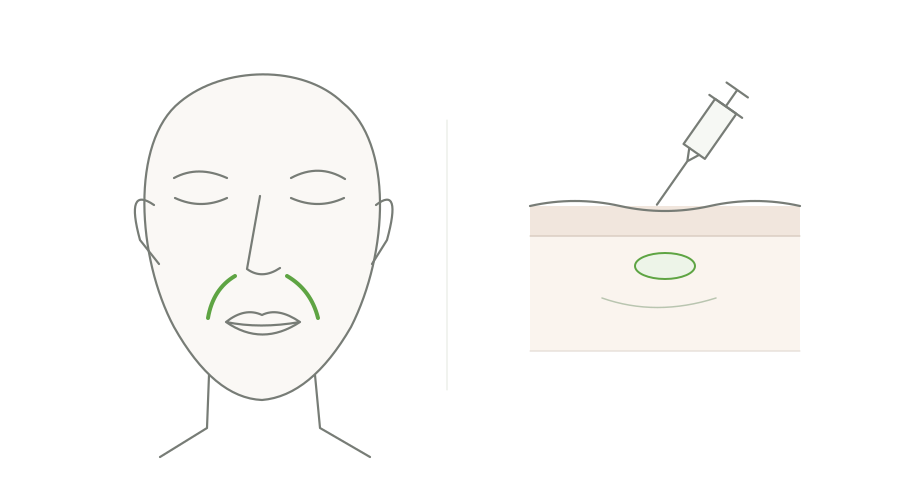
- Nasolabial region
- Individual planning
- Filler within tissue
From planning to follow-up
Assess the findings
Benefits, limitations, risks and alternatives are discussed.
Prepare and treat the skin
After cleansing and disinfection, filler is placed according to the individual plan.
Assess the result later
Swelling and bruising can change the initial appearance.
Allowing the result to settle
Swelling or bruising can change the initial appearance. What you see immediately after injection is therefore not the same as the later result. Avoid arranging treatment immediately before an important personal or professional event.
Advice on exercise, make-up, heat and pressure over the area is individual. Do not massage treated areas unless instructed. Hyaluronic acid does not provide a permanent result; the appropriate time for reassessment depends on how the area develops. More filler is not necessarily better, especially where loose skin is the main concern.
Duration, repeat treatment and the limits of adding volume
A visible change straight after injection is not a reliable settled result. Swelling can temporarily make a transition look smoother or more uneven. A scheduled review is therefore not automatically a top-up appointment: its first purpose is to assess benefit and tolerability.
Duration depends on factors including the material, area and individual course. Information about another facial region or another product is not a personal prediction. Ask what will guide repeat treatment: your current findings and concerns, not simply the number of months elapsed.
If tissue descent or pronounced skin laxity is the main concern, filler has limitations. Other procedures, or no further injections, may then be discussed. Surgery does not mean every nasolabial fold will disappear either; benefits, burden and risks must fit the overall findings.
Risks and warning signs
Possible effects include pain, redness, swelling, bruising, palpable irregularities, asymmetry, infection and delayed inflammation. Rarely, a blood vessel may become blocked, potentially causing tissue damage and, with facial injections, loss of vision.
Unusually severe or increasing pain and pale or mottled skin need immediate medical assessment. If you develop visual disturbances or neurological symptoms, call 112 immediately. Do not wait for a routine follow-up appointment. The consent discussion also explains what to do about other symptoms.
Make your consultation specific to your concerns
Bring records of previous fillers or facial operations if available, and mention firm areas, recurrent swelling or unusual changes. Previous cheek treatments matter even when your current concern is the nasolabial region. Unknown existing material calls for careful assessment, not a quick addition.
Tell us about medication, allergies, current symptoms and planned dental work. A recent infection or inflamed area needs discussion before an injection. Do not stop prescribed medicines yourself for a cosmetic appointment.
At Finke & Frantzen, Heinrich-Roller-Straße 15 in Berlin-Prenzlauer Berg, you discuss options, limits and the scope of treatment personally. Ask about your aftercare advice and what to do with concerns. Medical consultations carry a fee but do not commit you to treatment. This page does not prescribe a fixed filler quantity or price.
Further information
These pages explain other procedures and related concerns. They are not automatically alternative treatments for the same condition.
Finke & Frantzen
Your contacts in Berlin
Dr. med. Juliane C. Finke and Dr. med. Stephan Frantzen lead the Finke & Frantzen practice in Berlin. Read about their professional backgrounds here. Responsibility for your particular treatment is clarified when arranging your care.
Dr. med. Stephan Frantzen
View profileFrequently asked questions
Does the fold need to disappear completely?
No. A nasolabial fold is part of normal facial anatomy. Gentle softening may be more appropriate than trying to fill it completely. The goal is based on your examination.
Does cheek filler always help as well?
No. Cheek volume and nasolabial folds are related, but they do not automatically need treatment together. Any additional injection needs its own clinical justification.
Is this the same as botulinum toxin?
No. Hyaluronic acid adds volume; botulinum toxin reduces the activity of selected muscles. These approaches are not interchangeable.
How are costs determined?
Costs depend on the individual treatment plan and are explained personally. The medical consultation also carries a fee. We do not list fixed prices on this page.
Are nasolabial folds unusual in younger people?
No. They are part of facial anatomy and can be prominent in younger people, especially when smiling. Visibility alone is neither a diagnosis nor a reason to start injections early.
How much hyaluronic acid is needed?
An amount cannot reliably be derived from the apparent depth in a photograph. Tissues, previous treatment and the intended change need assessment. More material is not automatically better and may change your face in an unwanted way.
Is a blunt cannula automatically safer and risk-free?
No. The choice of needle or cannula is part of individual technique planning. No instrument eliminates all risks. Ask about the approach and warning signs rather than relying on a safety promise.
What about new lumps or swelling appearing later?
Have the change assessed even if some time has passed since treatment. Do not press, massage or arrange more injections without clarifying the cause. Acute severe pain, unusual skin colour or visual symptoms require immediate help.
Can skincare correct a deep fold like filler?
Skincare and volume treatment have different aims. A cream does not replace injected volume or surgical tissue repositioning. Conversely, this does not mean every visible fold needs a medical procedure.
Let us discuss your concerns
At Heinrich-Roller-Straße 15, 10405 Berlin, we discuss options, limitations and alternatives. Treatment decisions follow personal assessment and informed consent.
Medical consultations are subject to a fee. Treatment costs are discussed individually during your consultation.
Sources and context
Editorial source review: 7 October 2026. The practice website supports the consultation framework and available procedures. The cheek-volumisation study concerns a limited setting, not a universal outcome prediction. FDA information is used for filler safety, not to apply US authorisations to Germany. This information does not replace an individual medical consultation and examination.