For men · Breast surgery

Gynecomastia surgerymale breast reduction in Berlin

An enlarged male chest is common, and it is rarely talked about. What decides the operation is not the size but the tissue: gland, fat, skin — or a combination. Only an examination tells you which.

Please note: A medical consultation is a chargeable service under the German physicians’ fee schedule (GOÄ). Online bookings are binding; the practice team will explain the expected consultation fee when arranging your appointment.

Medically reviewed by Dr. med. Juliane C. Finke and Dr. med. Stephan Frantzen · Board-certified plastic surgeons · Last reviewed:

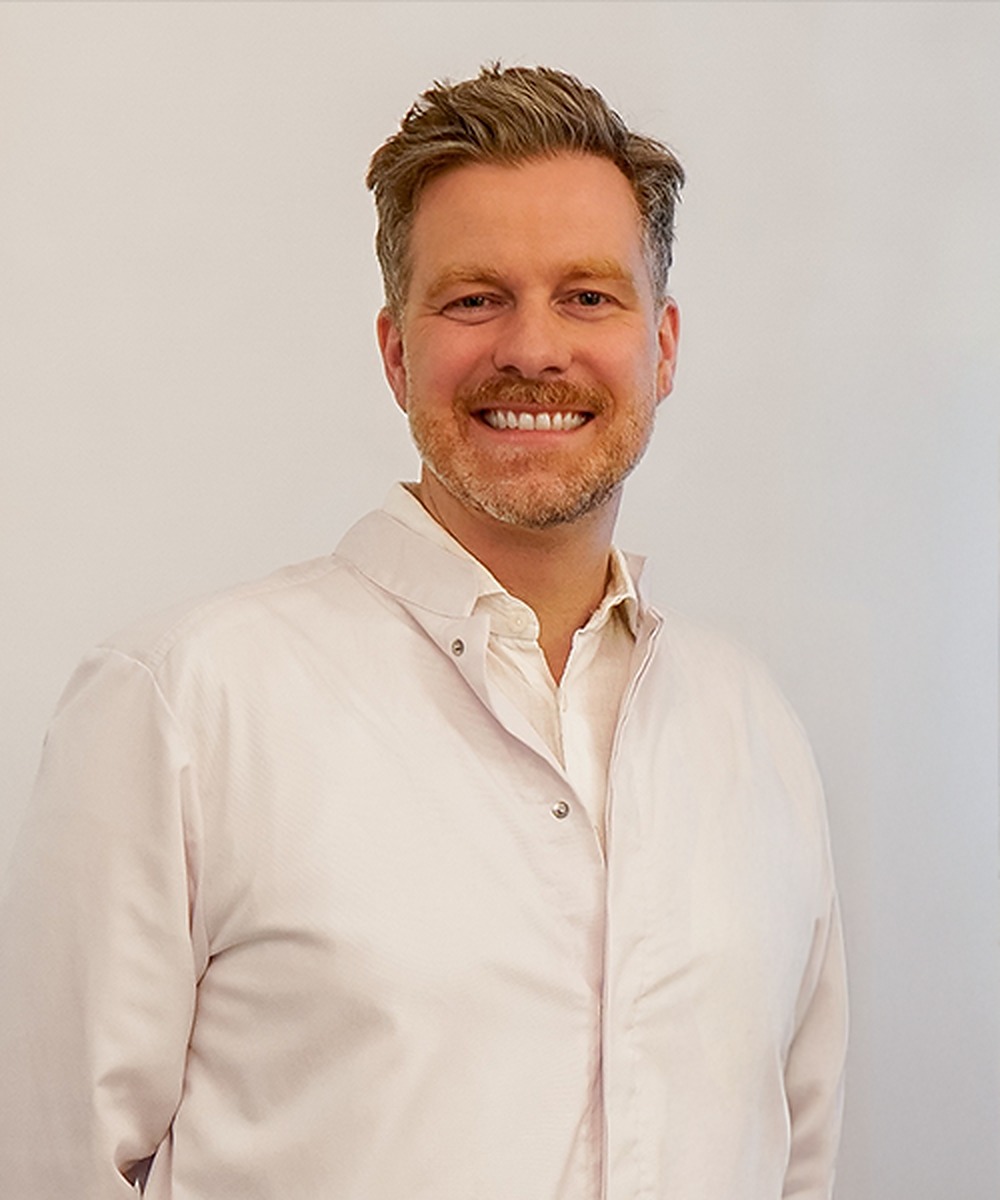
Dr. med. Stephan Frantzen in consultation with a patient at the practice in Berlin
60–120 minutes in theatre, depending on the technique used
Usually local anaesthetic a general anaesthetic where the procedure is more extensive
2–3 days rest; light desk work is possible after that
6 weeks no sport – and a compression vest is worn
General information

What is a male breast reduction?

Gynecomastia surgery — male breast reduction — treats a condition in which the male breast glands enlarge. It occurs on one side or on both.

Gynecomastia is typically characterised by an excess of fat, skin and/or glandular tissue, or a combination of all of these. The result is an enlarged appearance of the chest, and the chest can look out of proportion. There may also be a feeling of tightness, and swelling or protrusion of the nipples.

An estimated 40 to 60 per cent of adolescents at the age of 14 are affected; beyond that it is found in many men after puberty as well. Most often it is caused by an imbalance between male hormones (testosterone) and female hormones (oestrogen).

Although gynecomastia has no effect on general health, those affected can develop a negative body image, low self-esteem, and even depression and the isolation that follows — up to withdrawing from sport or from social contact. Many find that diet, exercise and weight loss are not enough to resolve it.

If the gynecomastia is still there after puberty, talk to us about the finding. The practice runs a dedicated men's clinic where you can be advised man to man.


An important distinction

True gynecomastia or pseudogynecomastia?

The word „gynecomastia" is often used loosely for any enlarged male chest. In fact there are two kinds, and they differ considerably.

True gynecomastia. Here the chest is enlarged primarily because of excess glandular or breast tissue. The cause may be genetic; equally, a hormonal disturbance or a course of medication can produce it. That has to be investigated before any treatment.

Pseudogynecomastia (lipomastia). This describes a chest that looks enlarged because of excess fat deposits. Lipomastia — also called false gynecomastia — often follows an unhealthy diet and too little exercise, but it can also result from a disorder of fat distribution.

Some men have both excess gland and excess fat. The distinction matters because one kind needs a different technique from the other. To establish which applies to you, book a confidential consultation: we examine you thoroughly and help you choose the treatment that fits.

Background

What causes gynecomastia?

Gynecomastia often appears as early as puberty. The exact cause is not known, and in the majority of cases no single cause can be established. A number of factors may contribute, however:

  • Weight loss or weight gain
  • Heredity
  • Problems with liver function
  • Plant-based testosterone supplements
  • Certain prescription medicines, including blood pressure medication
  • Anabolic steroids
  • Cannabis use

If the gynecomastia is caused solely by fatty tissue following weight gain, the first step is to change your diet and move towards a healthier lifestyle.

Classification after Simon

The four grades of male breast enlargement

Where the male chest is enlarged, the first question is whether it is genuinely gynecomastia — or whether something else is behind it. The Simon classification distinguishes four grades.

01

Grade I

Minor breast enlargement without excess skin.

02

Grade IIa

Moderate breast enlargement without excess skin.

03

Grade IIb

Moderate breast enlargement with minor excess skin.

04

Grade III

Marked breast enlargement with substantial excess skin.

Three techniques

How the operation is carried out

Gynecomastia correction is usually performed under local anaesthetic and takes one to two hours. Depending on the finding, one — or a combination — of three techniques is used.

1. The liposuction technique. If your gynecomastia is mainly down to excess fatty tissue, we recommend liposuction. One or two tiny incisions are made and the excess fat is removed with a fine cannula. Where there is excess gland, however, liposuction on its own is not enough.

2. Gland removal (subcutaneous mastectomy). Where there is excess glandular tissue, an incision around the areola is needed so that the firm gland can be cut out. The scar is positioned at the edge of the areola, but its eventual visibility varies with individual healing.

3. Skin and gland reduction. Where there is excess skin — after massive weight loss, for instance — liposuction and gland removal can also be insufficient. In those cases the skin is either tightened with a dedicated radiofrequency device or, in more severe cases, excised directly around the areola or along the natural chest folds.

Step by step

The two techniques in illustrations

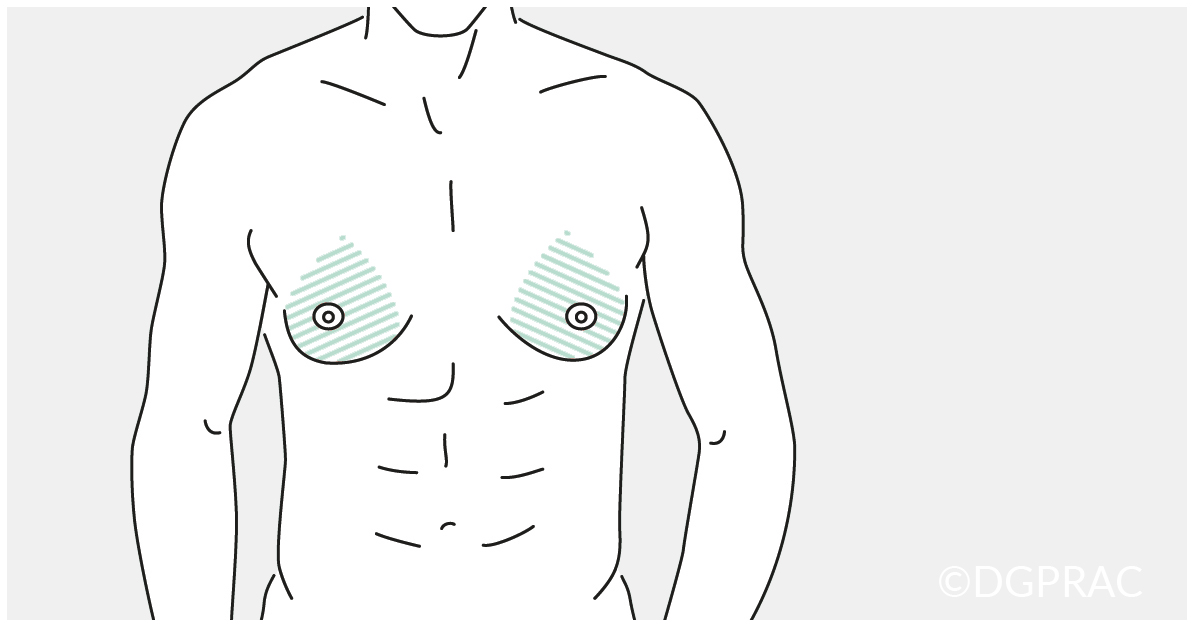
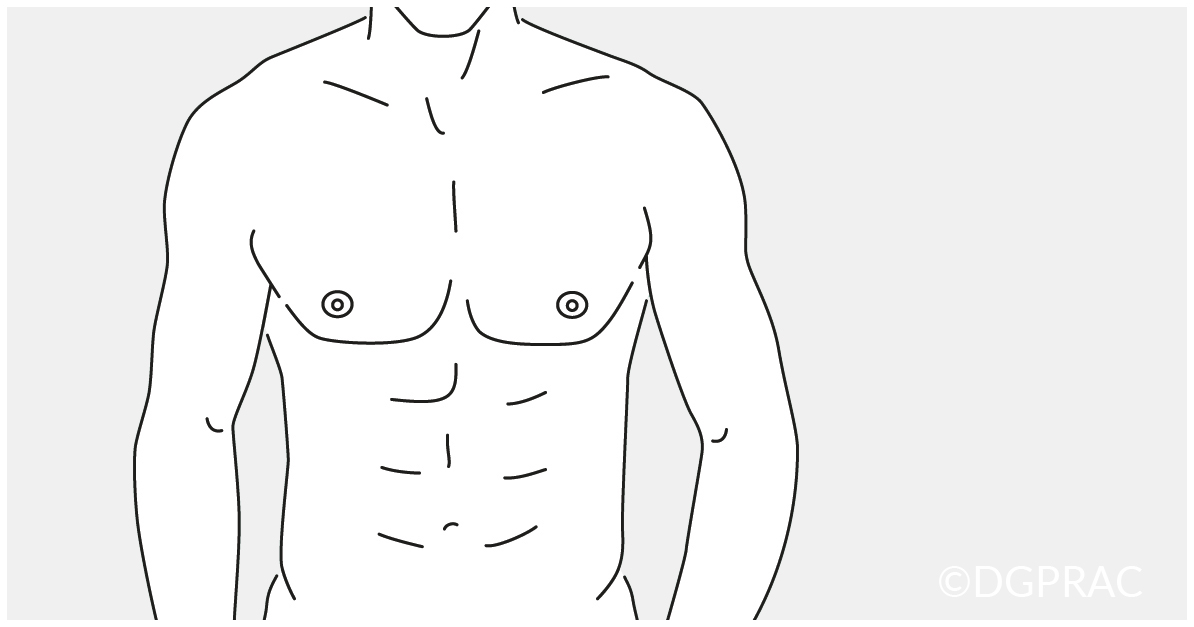
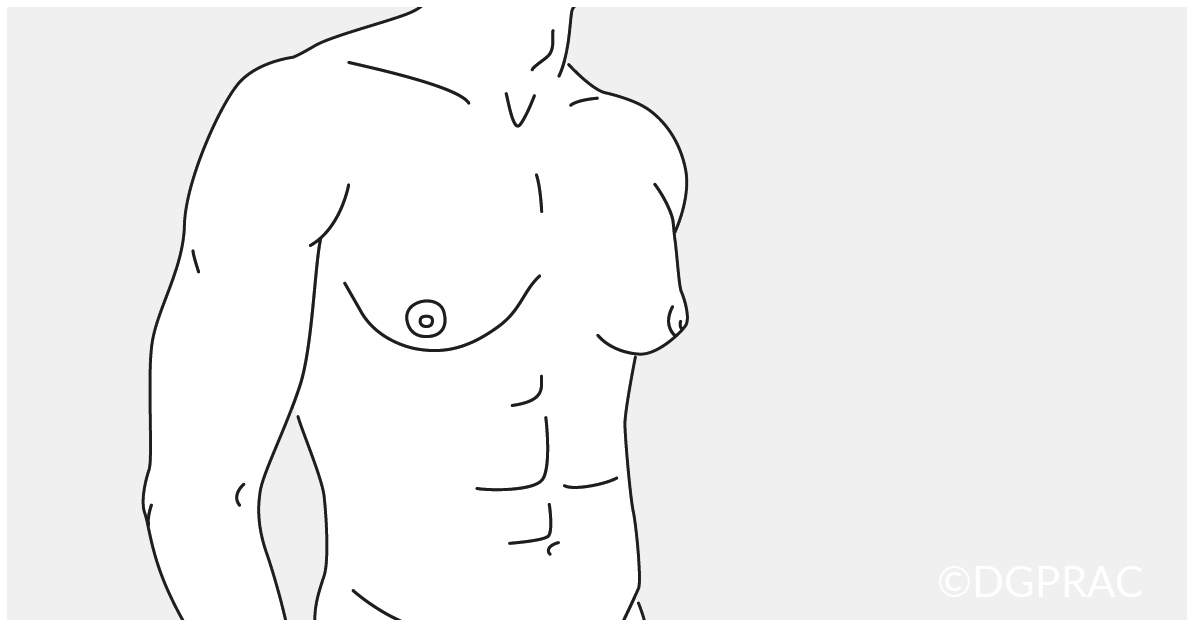
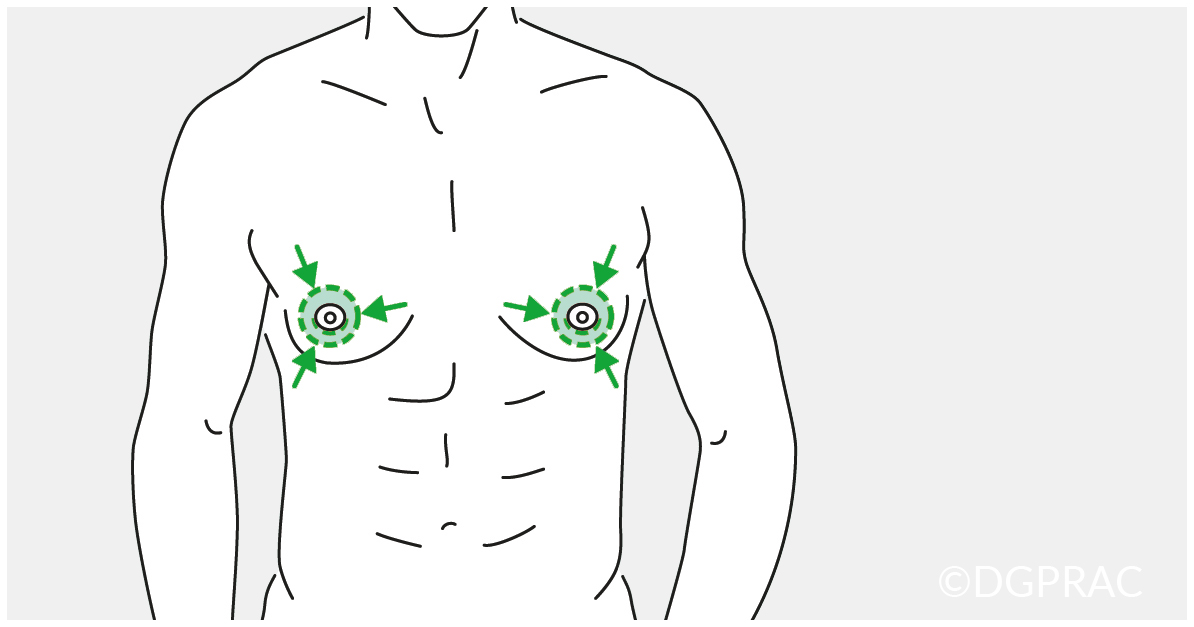
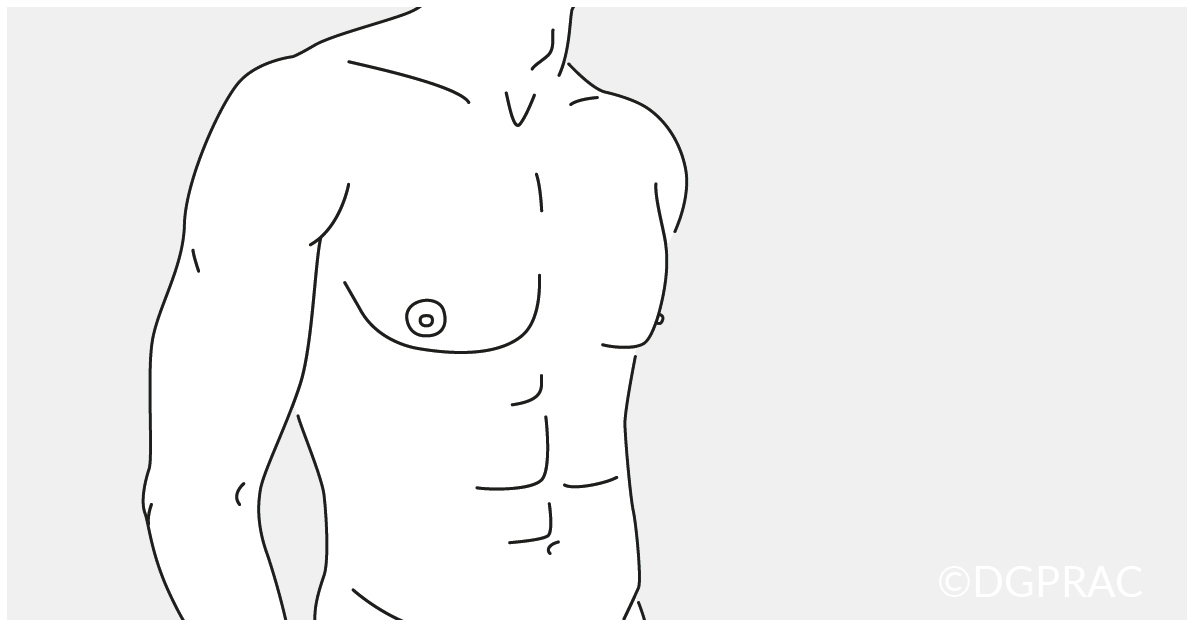
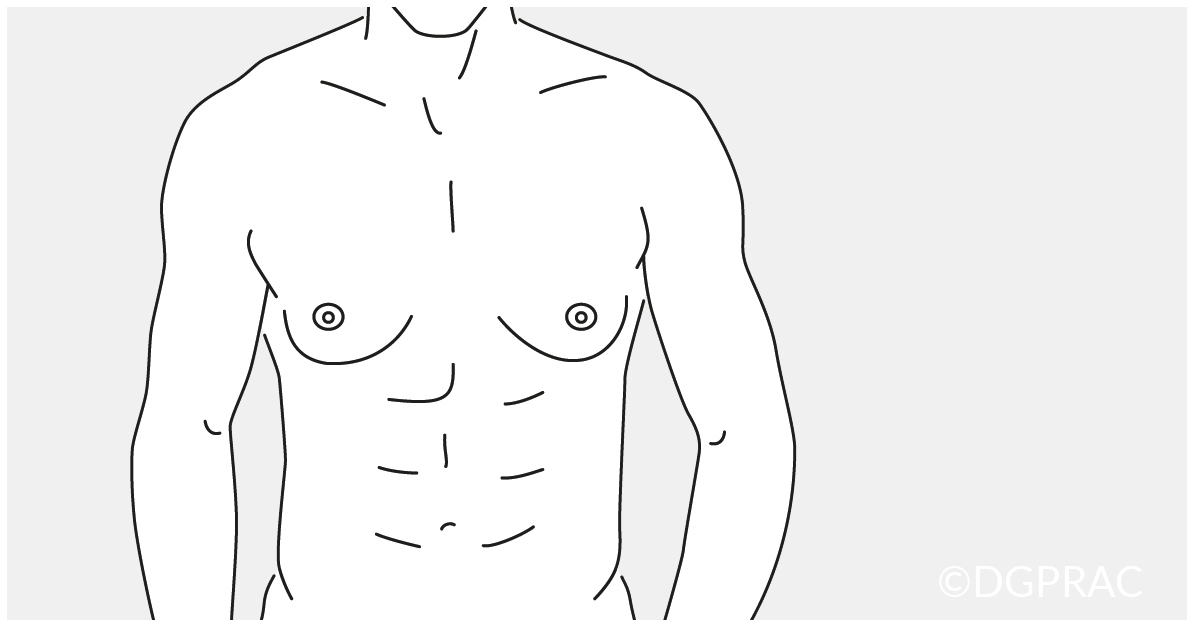
Above the liposuction technique, below gland removal (subcutaneous mastectomy). Illustrations: DGPRÄC.

Medical illustration: male torso with enlarged breasts, predominantly fatty tissue
1. Starting point: enlarged breast, predominantly fatty tissue.
Medical illustration: marked liposuction areas on the male chest
2. The procedure: excess fat is removed through one or two tiny incisions with a fine cannula.
Medical illustration: flat, defined male chest after liposuction
3. Result: a flatter, firmer chest contour.
Medical illustration: male torso with pronounced glandular tissue
1. Starting point: true gynecomastia with excess glandular tissue.
Medical illustration: incision around the areola for gland removal
2. The operation: the firm gland is excised through an incision at the edge of the areola.
Medical illustration: flat male chest after subcutaneous mastectomy
3. Result: the scar is positioned at the edge of the areola; its appearance depends on individual healing.
After the procedure

Aftercare and healing

After gynecomastia surgery it is important to rest for two to three days. Light physical work such as desk work can be resumed after that.

Following the operation you are given a dressing and a special compression vest that holds the new contour of the tissue in place. It should be worn for about six weeks. Sport also waits six weeks — after which every kind of sport, including weight training and bodybuilding, is possible again without difficulty.

Pain after the operation is comparable to bad muscle soreness and normally settles by itself after a short time; painkillers deal with it easily.

Complications. As a rule this is one of the uncomplicated operations. Rarely there can be bleeding, scar contracture, wound-healing problems, infection, thrombosis, embolism, visible scars, altered skin sensation, an uneven skin contour, asymmetry and/or skin necrosis. To avoid these, put yourself in the hands of an experienced board-certified plastic surgeon.

Safety

Risks specific to gynecomastia surgery

Possible complications include bleeding, infection, seroma, wound-healing problems, visible scars, contour depression or irregularity, asymmetry, altered nipple sensation, impaired blood supply to the nipple, persistent gland tissue, recurrence and revision surgery. Underlying causes and medicines should be assessed before an operation is planned.

At a glance

Gynecomastia surgery: the key facts

Key facts about gynecomastia surgery at Finke & Frantzen in Berlin
How long60–120 minutes – depending on the technique used
AnaestheticUsually local anaesthetic; a general anaesthetic where the procedure is more extensive
StayIn most cases day surgery at our practice in Berlin-Prenzlauer Berg. Where the procedure is more extensive, as an inpatient at the MEOCLINIC, Friedrichstraße 71 — the private hospital in Quartier 206
Back to work2–3 days rest, then light desk work
Afterwards6 weeks compression vest and no sport
ScarAt the edge of the areola; visibility varies with individual healing
TechniquesLiposuction, gland removal (subcutaneous mastectomy), skin and gland reduction
WhereDay surgery at our practice, Heinrich-Roller-Straße 15, Berlin-Prenzlauer Berg
Paid byPrivate fee – with true gynecomastia a medical indication may exist and an application to your insurer is possible

What does a gynecomastia surgery cost? There is no flat rate. Time in theatre, technique, anaesthetic and the extent of the procedure differ from person to person. You get a binding quote at the end of your consultation — in writing, with nothing hidden.

Will insurance pay? As a rule, no: purely aesthetic procedures are paid privately. German statutory insurers only contribute where a medical indication is recognised; private insurers and international policies decide case by case. We will tell you honestly whether you have any prospect of cover. With true gynecomastia involving glandular growth, a medical indication may exist depending on the finding. An application for cover is then possible; your insurer decides. And the consultation itself? Medical advice is a treatment in its own right and is invoiced under the German scale of medical fees (GOÄ) — including when you decide against a procedure afterwards. We tell you what to expect when the appointment is made.

Preparing

How do I prepare?

  • Stop blood thinners – aspirin, warfarin, ibuprofen – only after checking with us and your GP, usually ten to fourteen days beforehand.
  • Give up nicotine for two to four weeks before and after surgery. Smoking narrows the small skin vessels and is by far the most common cause of wound healing problems.
  • Come fasted on the day: nothing to eat for six hours, nothing to drink for two.
  • Arrange someone to take you home and, ideally, to stay the first night. No driving for 24 hours after a general anaesthetic.
  • Get things ready in advance: clothes that open at the front, the compression garment we agreed on, and enough food in for a few days.
  • Bring the compression vest in the size we agree, and comfortable clothing that buttons at the front.

These points apply generally. What applies in your case – with existing conditions or regular medication – we go through at your pre-operative consultation. That conversation is what counts.

Alternatives

What are the alternatives?

What lies behind the enlarged chest decides the procedure. In the consultation we look first at whether something smaller will do — and we tell you if none of them fits your finding. We look first at whether something smaller would do the job – and we will say so if none of these procedures fits your finding.

In safe hands

Your surgeons for gynecomastia in Berlin

Portrait of Dr. Stephan Frantzen, board-certified plastic surgeon in Berlin

Dr. Stephan Frantzen

Board-certified plastic surgeon and
board-certified general surgeon

  • Head of department for plastic surgery, Helios Klinikum Berlin-Buch, 2015–2018
  • Board-certified in two specialties – general surgery and plastic surgery
  • Lecture on gynecomastia – technique, avoiding errors and managing complications, DGPRÄC annual meeting 2013
Portrait of Dr. Juliane C. Finke, board-certified plastic surgeon in Berlin

Dr. Juliane C. Finke

Board-certified plastic surgeon (plastic &
aesthetic surgery), Fellow of EBOPRAS

  • Fellow of EBOPRAS – European board examination, 2010
  • Focus on breast surgery – aesthetic and reconstructive
  • Consultations in English and Spanish
Verifiable qualifications

Professional societies and awards

jameda award: patients rated Dr. Frantzen 1.0, highest recommendation for breast augmentation – open Dr. Frantzen's jameda profile jameda seal TOP 10 (01/2022): Dr. med. Juliane C. Finke, physicians for plastic & aesthetic operations in Berlin – open Dr. Finke's jameda profile

Dr. Juliane C. Finke and Dr. Stephan Frantzen are full members of the German Society of Plastic, Reconstructive and Aesthetic Surgeons (DGPRÄC) and the German Society of Senology (DGS). Dr. Finke is also a Fellow of EBOPRAS and passed the European board examination in 2010; Dr. Frantzen operates on a voluntary basis for INTERPLAST in South America. The jameda seals lead to the independent physician profiles with patient reviews of Dr. Finke and Dr. Frantzen.

Frequently asked questions

Frequently asked questions about gynecomastia surgery

Medically reviewed by Dr. Juliane C. Finke and Dr. Stephan Frantzen

01

Is it gland or is it fat?

That is exactly what the examination establishes, and it decides everything that follows. Glandular tissue feels firm and sits directly behind the nipple; fat is soft and spread more widely. Many men have both. Liposuction alone will not remove gland — which is why the distinction is made before, not during, the operation.

02

Will the scar be visible?

Where gland is removed, the incision usually runs at the edge of the areola. With liposuction there are one or more small access incisions. Every incision leaves a scar; colour, width and visibility vary with individual healing.

03

How long do I have to wear the compression vest?

About six weeks, day and night at first. It is not optional: it holds the new contour while the tissue settles, and it reduces swelling and discomfort considerably.

04

When can I train again?

Six weeks. After that every kind of sport is possible again, including weight training and bodybuilding, without restriction.

05

Can it come back?

Removed gland does not grow back. If the underlying cause is still active — a hormonal disturbance, medication, anabolic steroids — the tissue can change again, which is why the cause is investigated first.

06

Does insurance pay?

With true gynecomastia involving glandular growth, a medical indication may exist depending on the finding, and an application to a German statutory insurer is then possible. Purely fat-related enlargement is an aesthetic procedure and is paid privately. We document the finding for you; the insurer decides.

07

Is there a men's clinic?

Yes. The practice runs a dedicated men's clinic where you can be advised man to man.
Your next step

Talk to us man to man

Book a confidential appointment. We examine the finding, tell you whether it is gland or fat, and say plainly what each technique can and cannot do.

Medically reviewed by Dr. Juliane C. Finke, board-certified plastic surgeon (plastic, reconstructive and aesthetic surgery), and Dr. Stephan Frantzen, board-certified plastic surgeon and board-certified general surgeon.
Last medically reviewed:
The content of this page is for general information and does not replace medical advice. A binding assessment is only possible after a personal examination.

Independent information: The German Society of Plastic, Reconstructive and Aesthetic Surgeons provides patient information on choosing a specialist, consent, limitations and possible complications. The German Medical Association explains the GOÄ fee schedule. These German-language sources supplement, but do not replace, an individual medical examination.

Call us Book an appointment